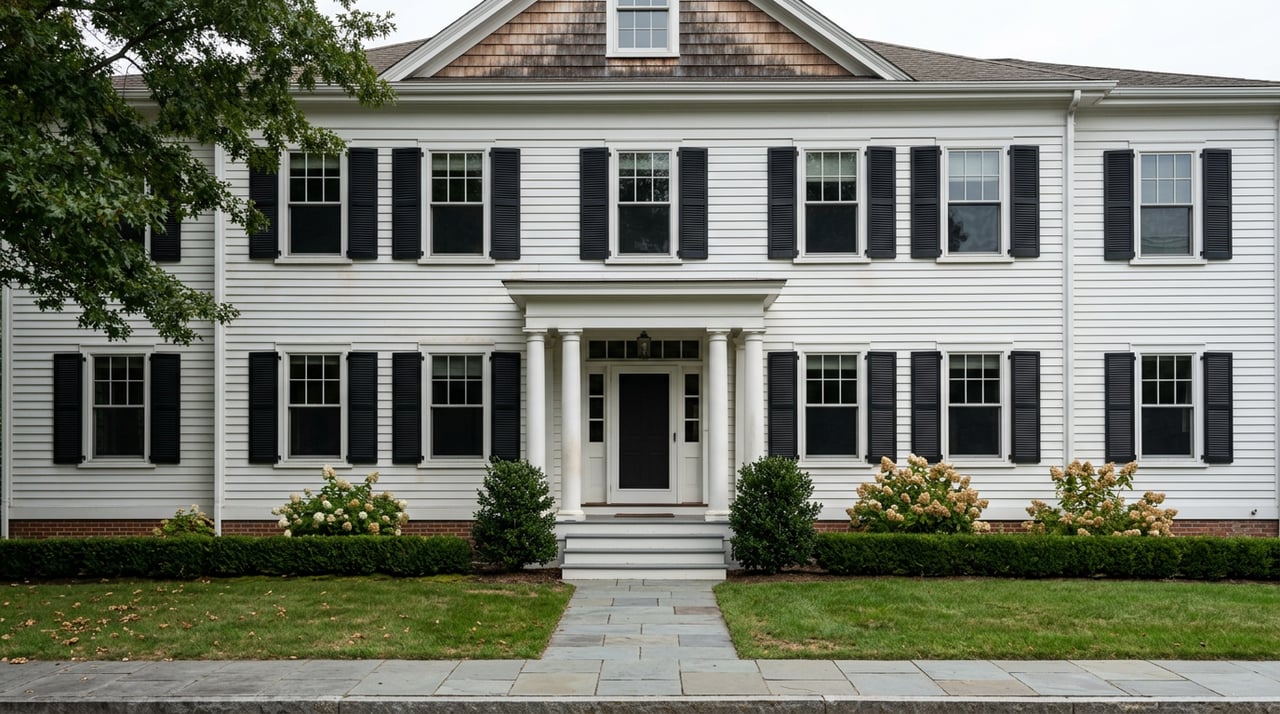
What to Know About the Spring Lake NJ Housing Market in 2026
August 13, 2026
August 13, 2026
Spring Lake's average home value sits above $1.5 million. The borough's Ordinance 2026-002 authorizes three affordable apartments at 1123 Third Avenue. Not three hundred. Three.
That is not a rounding error or a bureaucratic quirk. It is the borough's own math, and it tells you more about why prices behave the way they do here than any median-price headline will.
Under New Jersey's Fourth Round housing obligation, Spring Lake's Realistic Development Potential, the number of affordable units the state believes the town can actually accommodate, was set at three, according to the borough's 2025 Housing Element and Fair Share Plan. The borough is meeting that obligation with a single site: 1123 Third Avenue, at the corner of Third and Morris, the former Wells Fargo branch the town has held onto for years. Ordinance 2026-002, passed in February 2026, authorized a lease agreement to build it out: ground-floor commercial space, likely a restaurant, with three affordable two-bedroom units on the floor above. The borough's own preliminary application notice for the site confirms the address and the affordable-housing designation, with applications for the units opening in March 2026.
Three units, one address, is the project's stated scale. The borough's own affordable housing ordinance lays out the compliance mechanics in detail, but the practical result is simpler than the legal language suggests: there is nowhere else to put it.
Outside that one project, Spring Lake's 2026 development activity is happening almost entirely at the Planning Board, and almost entirely in the form of variance requests. A homeowner wants relief on a front setback. Another wants to exceed lot coverage. A third wants a use variance to convert part of a structure. None of these applications involve rezoning. None involve a master plan amendment. The zoning map itself has not moved.
That distinction matters for anyone comparing Spring Lake to other Shore towns where builders can still assemble parcels or push through a density change. Here, every expansion, every teardown-and-rebuild, every addition that pushes past what current zoning allows is a property-specific question.
This is where the scarcity story gets interesting for a buyer, because it shows up in the data in a way most portal browsing never explains.
| Source | Metric | Figure | Window |
|---|---|---|---|
| Zillow's home value index | Average home value | $1,516,856, up 13.8% | Year ending June 2026 |
| Homes.com | Median sale price | $1,202,500, essentially flat versus the prior period | Trailing 12 months, as of mid-2026 |
| Homes.com | Median days on market | 31 days (vs. 56 national) | Trailing 12 months, as of mid-2026 |
Read across that table and the story is not simply "prices are up." Zillow's index, which estimates value across the full housing stock, shows appreciation of nearly 14 percent in a single year. Homes.com's tracker, built from actual closed sales, shows the trailing median barely moved over that same stretch. Both can be true at once, and that is the point. With so few homes changing hands in a given quarter, an estimated-value index and a closed-sale median can tell two different stories about the same twelve months without either one being wrong.
That is the actual lesson buried in Spring Lake's numbers. When a town cannot add supply, meaning it cannot add the ordinary mix of new-construction starter homes, mid-size renovations, and larger builds that keep a market's price distribution stable, an index built on estimated values and a median built on actual closings can drift apart. Neither figure is broken. Both are measuring a market too thin to keep them moving in sync.
For a buyer, the practical takeaway is not "wait for prices to soften" or "act now before they rise further." Either of those reads too much into a statistic the market itself can't hold steady. The more useful question is about the specific lot in front of you, not the town-wide number.
A few things worth asking before you get attached to a property:
None of this shows up in a Zillow estimate. It shows up in the property file, the survey, and sometimes a conversation with the zoning office. In a market where the map itself is frozen, that homework does more to predict your actual outcome than any median price ever will.
Cost of ownership is worth grounding too. The median effective property tax rate in Spring Lake runs close to 1.08 percent, with a typical annual bill around $7,840, though bills range widely depending on assessed value, according to current Ownwell property tax data. That is a real number to build into an all-in comparison against other Shore towns where land is less scarce and prices, while still high, are not competing against a permanently fixed supply.
Spring Lake's home values are not high because the town is fashionable, though it is. They are high, and volatile in the way they're reported, because the supply side of this market stopped functioning as a normal market years ago. New construction is not a pipeline here. It is a single restricted project with three affordable apartments, surrounded by a Planning Board calendar of individual variance requests. Understanding that mechanism, not chasing whichever median a portal shows you this month, is what actually prepares a buyer to compete for one of the properties that does come up.
Is Spring Lake likely to see new housing inventory anytime soon? Not in the way most markets add supply. The borough's own housing plan describes virtually no developable vacant land remaining, and the one project at 1123 Third Avenue, is a three-unit build, not a broader development pipeline.
Why do home price estimates for Spring Lake vary so much between sites? With a small number of transactions closing each month, an estimated-value index and a closed-sale median are drawing from a very thin pool. One can show meaningful appreciation while the other holds nearly flat over the same twelve months, and both can be accurate readings of the same small market.
Does an existing home's current size limit what I can build later? The answer depends on the property.
If you're weighing Spring Lake against another Jersey Shore town and want to understand what a specific property's zoning history actually allows, Christopher Pizzola can walk through the file with you before you write an offer. Request a private consultation to start that conversation.
This article is general information, not legal, tax or financial advice. Consult a qualified professional about your situation.
Stay up to date on the latest real estate trends.


Providing his clients with a true luxury brand and representation is the foundation of his business. Contact him today to find out how he can be of assistance to you.